
SQL Server 2025 and the End of Purview Access Policies: A Step Back from Cloud-Native IAM?
SQL Server 2025 was released at the end of last year. While most attention has gone to new features, this release also discontinued several existing ones—a notable first in recent SQL Server versions.
The full list is available here: Discontinued services and deprecated features
One item deserves particular attention: Purview access policies.
This feature had only reached GA in November 2022(Microsoft Purview DevOps policies enter GA: Simplify access provisioning while protecting your data )
Status (as of April 2026):
- DevOps / Data Owner policies are discontinued in SQL Server 2025 (on-prem) and no longer supported there
- The feature continues to work in Azure SQL Database + MI (as well as SQL Server 2022)
- There is no clear public guidance on the long-term plan or removal timeline for Azure SQL
- This introduces some uncertainty for customers, especially in hybrid environments where consistent access control models are often expected.
What Purview access policies were meant to solve
The intent of the feature is best illustrated by the following diagram:
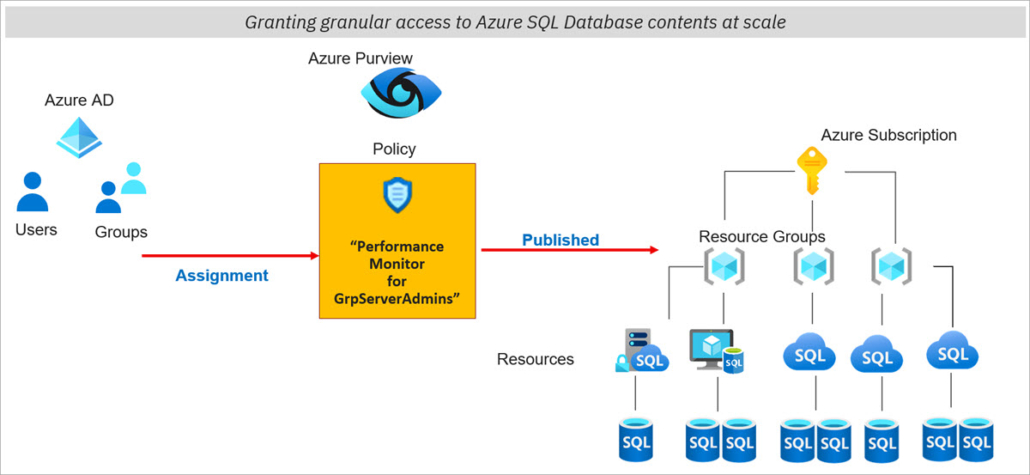
Source: Private Preview: controlling access to Azure SQL at scale with policies in Purview
Disclaimer: I worked extensively on this feature during my time at Microsoft on, along with several others. But this post is not sentimental—it is based on a question about the product’s strategy,
DevOps policies were the first step toward integrating the SQL Server engine into a cloud-native IAM model.
“One policy to control them all”.
The idea was to define RBAC-style roles that could grant access across all SQL Server Instances and SQL databases at subscription or resource-group scale.
The key benefit was scale: instead of executing SQL scripts against every instance (and dealing with outages, drift, or newly created servers), access could be centrally managed via policies.
DevOps policies were the first permissions exposed to external policy control. The primary use case was read-only access to system objects, typical for:
- Performance monitoring tools
- Junior DBAs
- Support staff
- Security auditing
Why Purview? – Why not Azure RBAC?
Purview was not the original plan—it didn’t even exist at the time.
The logical choice was Azure RBAC, but there was no budget to integrate with it. The relevant teams were fully focused on Entra ID.
At the same time, a new product (codename Babylon) was being built to provide unified visibility for data assets. That product became Microsoft Purview. The Purview team provided strong engineering support, which ultimately led to access policies being implemented there.
Why did we start with DevOps policies (read-only access to system objects for Performance Monitoring and Security Auditing) and not access to data?
We were under no illusion that DevOps policies alone would drive Purview adoption.
However, after spending significant time on internal architecture, we needed to deliver a minimal but real use case. Performance monitoring had the smallest permission surface.
The architecture is described here: Revamped SQL Permission system for Principle of Least Privilege and external policies – internals
Time constraints forced a choice:
- Read access to system objects
- OR SELECT on user tables only (no views, procedures, or functions)
I chose the read-only access to system objects. Rolling out “SELECT on tables only” would have been misleading: real applications also need views, stored procedures, and write access. No customer would want to work with a split connection model per application just to fit a partial policy model for one of them.
Why did Microsoft decide to kill this project?
I can’t provide an official statement, but I’ve spoken with people involved.
Two facts stand out:
- Almost everyone from the original Purview and SQL PM teams has left.
- Customer adoption of the feature was very low.
Given Purview’s complex setup and limited adoption, this is unsurprising. I would not recommend customers deploy Purview solely for two DevOps policies.
Additionally, the Purview team has shifted focus toward Data Catalog and MIP labels, ending support for SQL access policies.
From that perspective, the decision is understandable.
What’s missing, however, are two key considerations:
1. What is the long-term goal of policy-based access control?
DevOps policies were never meant to be the end state. They were proof that the architecture works. Roles covering user objects, DDL, and broader SQL operations were already defined and waiting for implementation.
The long-term vision was to allow any SQL permission to be governed by external policies—and eventually, if desired, eliminate SQL authentication entirely.
2. Are there alternatives to Purview?
If Purview is the blocker, why not switch providers?
The architecture was explicitly designed to be policy-provider agnostic. Purview is not the only option. We made sure of that.
Is there an alternative?
The Documentation suggests using fixed server roles instead.
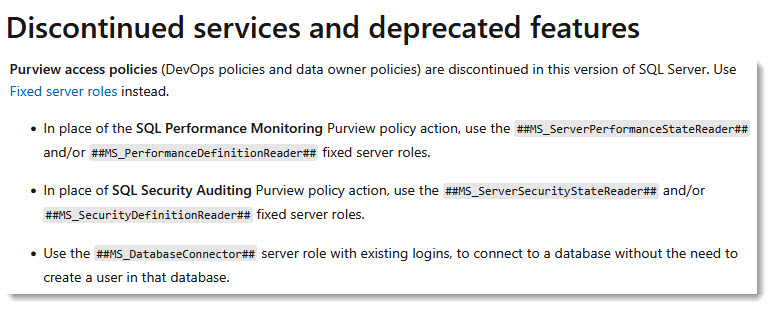
This is incorrect.
Server roles are per-server and require logins on each instance. And SQL Server permissions alone do not have a concept of Separation of Duties.
- Server roles are per server and require a login at each server.
- The policy-based access works across servers, covering all servers within a subscription if you wish – that is the whole point of the feature: scale.
- Policies do not require a SQL login. They are truly cloud-native. This is how IAM for cloud resources should work. Server roles are just standard SQL roles that you can assign members to once you have a login in SQL.
- Separation of Duties:
The workflow for assigning RBAC roles in Purview is intentionally split into two steps:
- Step 1: Define the policy
- Step 2: Approve (publish) the policy
This enforces Separation of Duties, as two different personas are involved in the process of granting access.
Why I think this is a strategic mistake
Customers managing hundreds and thousands of SQL servers and databases – cloud and on-prem – have the constant challenge to keep access to those systems tight and yet manageable. Running SQL commands with PowerShell to deploy Logins and permissions, hoping that all servers are online is unsatisfying and inefficient. The “PowerShell to remote into SQL after Deployment”-approach does not scale well, and lacks the central visibility of who has access to which database.
In addition to that, the workflow that was designed in Purview supports Separation of Duties, which has been a long-time ask from customers with critical systems.
Vendors like Google and Amazon have for good reasons invested in IAM for their database offerings.
If cloud is a priority, cloud-integrated access control must be part of the strategy.
My advice to the Microsoft product team
Even with the discontinuation of access policies, the architecture is still in place. It is used by the Data owner policies and even by Fabric workspace roles behind the scenes (albeit with a very hacky implementation).
Rather than removing the feature, consider Azure RBAC as the policy provider. It is the natural IAM system for Azure resources, and the policy-integration within the SQL engine technically supports alternative policy sources—including on-prem ones.
————————————————————————————————————————-
What do you think? Is integrated access control overrated?
How and where do you want to define access to databases across your subscription?
Andreas


Why does the author believe Azure RBAC would have been a better policy provider than Purview?
A) Because customers have multiple times expressed that they would like to rather use Azure RBAC than having to consider a separate technology which on top is (1) very price-extensive and (2) complex to set up
B) Because Azure RBAC did already exist and did not need to be built from scratch
Thanks for this article. We use Purview specifically to assign SQL Performance monitoring permission(s) to our DBA(s) across many resource groups in Azure to monitor Azure SQL databases. Without Purview it would make it much more complicated to track those permissions across so many databases we have. However, as of now (2/16/2026) it still works even though Azure SQL always reports the latest version of SQL Server (2025) being used. Not sure when exactly they are going to switch it off completely. Do you have any insight on the actual discontinuation date?
Hi Andrew
thanks you for sharing that you are using this feature.
Let me check with the team.
And I am still hoping for a reversal in this position. Such comments are valuable to make that case.
Hi Andrew,
Quick update on this – I haven’t been able to get a clear answer so far regarding an actual discontinuation timeline.
As you’ve observed, the policies are officially discontinued but still functional in practice, which makes it difficult to assess how long they can be relied on.
From a governance perspective, I’d be cautious about depending on them long-term until there’s clearer guidance or a defined replacement.
If I hear anything more concrete, I’ll update here.
Hi Andreas,
I appreciate you getting back to me on this. As mentioned earlier we use Purview to manage dozens of Azure SQL DBs and so far successfully. Hope MS changes their mind and reverts their decision on this. Let us know if there are news on this.
Thank you,
Andrew
Hi Andrew,
thanks again for sharing your scenario – that actually helped clarify things further.
I did get some additional feedback in the meantime:
The DevOps / Data Owner policies have been discontinued for SQL Server 2025 (on-prem) and no longer work there.
However, they continue to work for Azure SQL (including MI as well as SQL Server 2022), which explains why your current setup is still functioning.
That said, there is still no clear public guidance on the longer-term plan or timeline for Azure SQL, which is where the uncertainty comes from.
In practice, I would treat this as a capability that is still available and supported today in Azure SQL, but where it would be wise to keep an eye on potential changes and possible alternatives over time.
The split between on-prem and Azure makes this a bit confusing – especially in hybrid environments – and hopefully we’ll see clearer guidance on the long-term direction.
I’ll update the post if anything more concrete becomes available.
Thanks,
Andreas
PS: if you still have questions, I can get you in touch with the Program Manager who took over this feature. Just send me an Email in that case and I’ll connect you.