Andreas Wolter
  • Consulting & Services
    • SQL Server Security Assessment by Andreas Wolter
    • SQL Server Health Check
    • Performance Analysis
    • SQL Server Discovery
    • Air-Gapped SQL Server
  • My Customers
  • About
    • Conferences
    • Certifications
    • Training
  • Blog
  • Contact
  • Click to open the search input field Click to open the search input field Search
  • Menu Menu

Tag Archive for: Columnstore

Posts

One day of “In-Memory Technologies in SQL Server”

11. July 2017/in Conferences & Speaking, Performance

It is no secret that I have been very active in the Asian region the last years – mainly in Singapore, Malaysia and India. So, it may not be a surprise that this summer I will be giving a full day PreCon at the now called “Data Platform Summit” in India’s hub for information technology: […]

Read more
https://andreas-wolter.com/wp-content/uploads/2017/08/dps2017_logo-e1502276476390.png 126 223 Andreas Wolter https://andreas-wolter.com/wp-content/uploads/2026/10/Andreas-Wolter-Data_Security_Architect-dark.png Andreas Wolter2017-07-11 17:12:402017-10-17 18:13:41One day of “In-Memory Technologies in SQL Server”

SQL Server 2016 SP1 removes the editions’ programming feature limits!

16. November 2016/0 Comments/in Performance

These are just sublime news, there is no other way to put it: With the Service Pack 1 for SQL Server 2016 released today, Microsoft puts an end to the programming-technical differences between the editions (LocalDB, Express, Standard, Web, Enterprise)! As of today, EVERYONE who is already working on SQL Server 2016 can create In-Memory […]

Read more
https://andreas-wolter.com/wp-content/uploads/2016/11/SQLServerServicePack-1024x567-e1505486877626.png 111 200 Andreas Wolter https://andreas-wolter.com/wp-content/uploads/2026/10/Andreas-Wolter-Data_Security_Architect-dark.png Andreas Wolter2016-11-16 10:02:482017-10-17 18:33:16SQL Server 2016 SP1 removes the editions’ programming feature limits!

Index-Cheat-Sheet. The complete Index-compatibility Matrix for SQL Server

1. August 2016/3 Comments/in Performance, Scripts & Tools

With the total of 4 new index types we have gained since SQL Server 2012 now we also have a total of 4 basic formats (Heap, Clustered Index, Clustered Columnstore Index, memory-optimized “varheap”) for data storage in SQL Server. And what’s more, with SQL Server 2016, these can be combined in various ways.

Read more
https://andreas-wolter.com/wp-content/uploads/2017/09/1607_SQL_Server_Index_Compatibility_Matrix.png 316 853 Andreas Wolter https://andreas-wolter.com/wp-content/uploads/2026/10/Andreas-Wolter-Data_Security_Architect-dark.png Andreas Wolter2016-08-01 16:45:332017-10-18 10:38:59Index-Cheat-Sheet. The complete Index-compatibility Matrix for SQL Server

The SQL Server 2016 In-Memory Evolution – from row-store to columnstore to in-memory operational analytics

1. July 2016/0 Comments/in Conferences & Speaking, Performance

SQL Server 2016 is finally available and, by extension, the “version 2” of the In-Memory OLTP Engine, if you will. At various international conferences and already at the IX in 2014 I have presented what is behind the In-Memory Engine of SQL Server introduced in SQL Server 2014. Only I had not yet found the […]

Read more
https://andreas-wolter.com/wp-content/uploads/2016/07/1606_SQL2016_Real_time_operational_analytics_previewcut.png 394 559 Andreas Wolter https://andreas-wolter.com/wp-content/uploads/2026/10/Andreas-Wolter-Data_Security_Architect-dark.png Andreas Wolter2016-07-01 17:13:312017-10-18 10:44:27The SQL Server 2016 In-Memory Evolution – from row-store to columnstore to in-memory operational analytics

Conferences in SQL Server summer 2016

17. May 2016/in Conferences & Speaking, Performance

It feels like I have just been back from the SQLBits XV in Liverpool, where I introduced the Security Features of the SQL Server 2016 (SQL Server 2016 – Security Obscurity and Encryption), and next thing I know, I am already in the middle of planning the next SQL Server Master-Class on High Availability with […]

Read more
https://andreas-wolter.com/wp-content/uploads/2017/11/1605_Singapore.jpg 415 615 Andreas Wolter https://andreas-wolter.com/wp-content/uploads/2026/10/Andreas-Wolter-Data_Security_Architect-dark.png Andreas Wolter2016-05-17 18:04:032017-11-30 18:13:36Conferences in SQL Server summer 2016

SQL Server 2016 – the Security & Performance Release

31. May 2015/2 Comments/in Security, Performance

The news broke in early May: That’s when Satya Nadella presented SQL Server 2016 at the Microsoft Ignite-Conference in Chicago. I can already say that SQL Server 2016 will be one of the most exciting releases in recent years. And that’s because this time it’s clearly focused on security. Next to performance features, security features […]

Read more
https://andreas-wolter.com/wp-content/uploads/2015/05/1505_SQL2016_Key_Innovations_SQL_Server_2016_previewpic.png 386 688 Andreas Wolter https://andreas-wolter.com/wp-content/uploads/2026/10/Andreas-Wolter-Data_Security_Architect-dark.png Andreas Wolter2015-05-31 15:29:572017-10-18 17:18:27SQL Server 2016 – the Security & Performance Release

Article “SQL Server 2014 – New Fundament” in iX Issue 5/2014

8. May 2014/0 Comments/in Performance

In the May-issue of the iX, on page 56, there is an article by me which I wrote together with my colleagues Volker Heck (Cloud- and BI-Part) and Holger Schwichtenberg (copy-editing).

Read more
https://andreas-wolter.com/wp-content/uploads/2017/11/1405_Artikel_ix_previewPic.png 330 513 Andreas Wolter https://andreas-wolter.com/wp-content/uploads/2026/10/Andreas-Wolter-Data_Security_Architect-dark.png Andreas Wolter2014-05-08 19:25:082017-11-30 19:42:30Article “SQL Server 2014 – New Fundament” in iX Issue 5/2014

SQL Server 2014 CTP2 released at PASS Summit / public download

16. October 2013/0 Comments/in Performance

As I have expected, today, Oct. 16th the CTP 2 of SQL Server 2014 was published at dem SQL PASS Summit in Charlotte USA. 🙂
I am expecting the final to come along in the first quarter of 2014.

Here is the link to the download:

technet.microsoft.com/en-US/evalcenter/dn205290

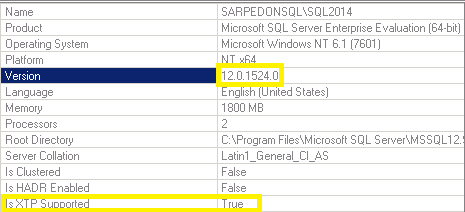
SQL_Server_2014_CTP2_VersionInfo

A short overview on the New Features in the Database-Engine part in this release – cumulative to the new features from CTP1, which I have listed here already before:

  • AlwaysOn
    • Up to 8 secondary replicas
    • In case of loss of quorum, read-only replicas remain available for read-access
    • Failover cluster instances (FCIs) can use Cluster Shared Volumes as cluster shared disks in Windows Server 2012 and above
  • Database Engine
    • Single Partition Rebuild
    • Lock Priority Management for Online-Operations
    • Incremental Statistics
    • Resource Governor support for physical IO
    • New Extended Events: 775 total, 152 more than SQL 2012 SP1, 12 since CTP1
  • In-Memory OLTP aka Extreme Transactional Processing (XTP, formerly Codename “Hekaton”)
    • B-tree indexes (Hash indexes since CTP1)
    • Delayed Transaction Durability

SQL_Server_2014_CTP2_Delayed_Durability_Database_Option

Security:

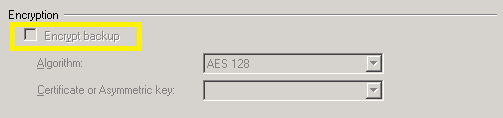
  • Encrypted Backups
  • New permissions (more on that soon in my blog, especially also in addition to the „CONTROL SERVER“-Topic

SQL_Server_2014_CTP2_Backup_Encryption_SSMS

In Reporting Services and Integration Services there are no changes.

The complete list can be found here: msdn.microsoft.com/en-us/library/bb510411(v=sql.120).aspx

Added to that there are many new enhancements connected with SQL Azure and in the area of BI & Information Services. I will leave detailed reports on those to my valued colleagues and will link to the respective blog-posts once ready.

Note: Upgrading from CTP1 to CTP2 is not supported.

Have fun with SQL Server 2014 CTP2

Andreas

https://andreas-wolter.com/wp-content/uploads/2026/10/Andreas-Wolter-Data_Security_Architect-dark.png 0 0 Andreas Wolter https://andreas-wolter.com/wp-content/uploads/2026/10/Andreas-Wolter-Data_Security_Architect-dark.png Andreas Wolter2013-10-16 12:00:002026-10-28 22:49:23SQL Server 2014 CTP2 released at PASS Summit / public download

The Columnstore Indexes & Batch Mode Processing (R)Evolution in SQL Server 2014

30. June 2013/0 Comments/in Performance

aka “Apollo has landed”

(Apollo was the Codename for the Columnstore Index project before SQL Server 2012)

Whereas In-Memory Transactional Processing with XTP builds the foundation for the shift in processing OLTP in SQL Server 2014, for OLAP/datawarehouse-systems Columnstore Indexes have been improved fundamentally. In fact the improvements are so huge, that it can be foreseen that Columnstore will become the standard type of storage for DataWarehouses starting in SQL Server 2014 (at least for systems running Enterprise Edition).

Let’s start with what we had and missed at the same time so far, in SQL Server 2012 when Columnstore Indexes were introduced:

  1. One Non-clustered columnstore index (I’ll refer to that as NCCI from now on) per table – the clustered was still row-based
  2. No DML support: no updates (data refresh) – biggest bummer for close to real-time DataWarehouses and continuous updating
  3. Mediocre memory management – i.e. Resource Governor not honored
  4. No batch hash join spilling
  5. Limited data types support – ok, I personally have little problems with that as it forced developers to wisely chose column-types and table design (remember, that columnstore indexes were mainly meant for FactTables in DataWarehouses), but that’s just my personal opinion on that 🙂
  6. Limited batch operations supported – one unsupported plan operator led to row-mode processing of the whole query

Out of that list, probably the biggest issues in SQL Server 2012 are, that updates to columnstore indexed tables are only possible by drop NCCI/load data/create NCCI or partition switching and secondly: many queries actually do not get even get all of the possible performance gain from the NCCI because of an unsupported operation inside the query (plan).

At the TechEd Europe 2013 in Madrid CTP1 of SQL Server 2014 was announced publically available (andreas-wolter.com/ctp1-sql-server-2014-release-techedeurope/ ) and as detailed information on the big improvements are finally official, I can share the good news with my readers (Big Thanks to Igor Stanko from the Parallel Datawarehouse-Team at Microsoft who answered all questions in detail, while “bound” with me and other MCMs and MVPs at the Microsoft booth 😉 )

To the facts:

In SQL Server 2014,

  1. We can create a Clustered Columnstore Index (CCI)
  2. Clustered Columnstore Indexes will be Updatable with standard DML-Operations! – this works via a delta store and a tuple mover, that converts a once full segment into column store
  3. Memory management is dynamic and honors resource governor settings
  4. (Hash Join) Spilling now supports Batch Mode
  5. Mixed row and batch mode inside query execution now works
  6. We have more supported operators in batch mode (Outer Join, partial Aggregates, Union All)
  7. The new compression type: “COLUMNSTORE_ARCHIVE” adds another 30% compression for chosen table/partition
  8. More data types are supported (high precision decimal, (var)binary, uniqueidentifier)

Clustered ColumnStore Index Insert:
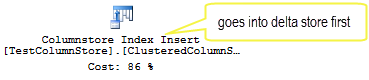
Clustered ColumnStore Insert

– Those improvement combined can hardly be overestimated as they ultimately lead to one conclusion:

“Columnstore (and clustered columnstore index) will be PREFERRED storage engine for DW scenarios”

(this is an official quote from Microsoft – and I see no need to say it any differently)

Note: The Clustered Columnstore Index feature is was actually developed by the Parallel Data Warehouse (PDW)-Team for the PDW Version 2012 which was released in the beginning of 2013. (Thanks, Henk van der Valk for reminding me of that not so insignificant fact.)

And here is a comparison of the possible space savings when using CCI over any other indexing methods so far (released at TechEd 2013 – I’ll let the graph speak for itself):
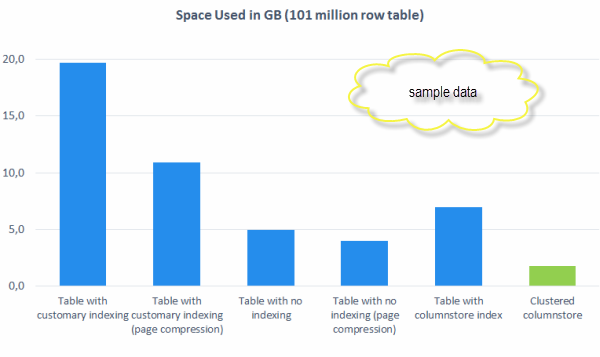
Space savings with Clustered ColumnStore

After all the good news: Is there anything that we might still miss when using ColumnStore? I do not want to forget to mention the few things that might still hurt:

  1. No constraints using index are supported, not even Foreign Keys without index. So if such is needed, one has to revert to using a hybrid approach with NCCIs and using partition switching or any other of the methods as before.
  2. Also DML-Triggers are not possible with CCIs.
  3. Just for completeness: no other indexes are possible when a CCI is present on a table. But there is no use for it anyways, as the attentive reader might have noticed by now 🙂

So, as a datawarehouse-architect I am really excited and looking forward to the first implementations of Datawarehouses under SQL Server 2014. The index-design will become much easier, in fact in many environments even trivial. – Note, that I am not using the word “database-design” itself: A proper database-design (hint: “star-schema”) is still necessary to get the maximum performance gain possible – don’t forget that batch mode processing and segment elimination are the keys to the max.

happy indexing

Andreas

https://andreas-wolter.com/wp-content/uploads/2026/10/Andreas-Wolter-Data_Security_Architect-dark.png 0 0 Andreas Wolter https://andreas-wolter.com/wp-content/uploads/2026/10/Andreas-Wolter-Data_Security_Architect-dark.png Andreas Wolter2013-06-30 12:00:002026-10-28 22:49:14The Columnstore Indexes & Batch Mode Processing (R)Evolution in SQL Server 2014

Security Assessment Community Edition

Learn about my free Community Edition script.

Recent
  • Sample result in SSMS: local NTLM connections over shared memory from SQL01, and NTLM connections over TCP from a reporting server, an ETL server and a workstation
    NTLM Deprecation and SQL Server: How to Find NTLM Connections...18. November 2026 - 17:01in: Security
  • SQL Server Consolidation: $3M+ in Projected Savings and...30. September 2026 - 15:47in: Architecture & High Availability, Security
  • Using a Database Server as a Honeypot for Threat Detect...18. September 2026 - 16:00in: Security
  • Azure Arc for SQL Server: “Least Privilege” Mode Still...8. September 2026 - 15:56in: Security
  • When SIEM Enrichment Becomes False Attribution3. September 2026 - 14:26in: Security
Comments
  • Thanks Scott. Goof feedback. NETSTAT is a useful addition,...21. November 2026 - 15:44 by Andreas Wolter
  • I would go a little deeper with how to troubleshoot SQL...21. November 2026 - 15:15 by Scott O
  • Protecting database data at rest is essential for maintaining...21. October 2026 - 2:23 by Viska
  • Thanks Now Microsoft could document them as well, and put...19. August 2026 - 16:26 by Andreas Wolter
  • List of Action_IDs for Filter https://sqlquantumleap.com/reference/server-audit-filter-values-for-action_id/ Great...18. August 2026 - 0:59 by Peter Dünsch

Articles

Analysis Services Auditing Availability Groups Azure Best Practices Certification Columnstore Consolidation Deadlocks & Blocking Encryption Extended Events Get-SqlSafe In-Memory OLTP Indexing Least Privilege PASS Summit Patching Performance Analysis Permissions Privilege Escalation Reporting Services Security Principles Spatial Data SQLBits SQL Injection SQLSaturday SQL Server 2012 SQL Server 2014 SQL Server 2016 SQL Server 2022 SQL Server 2025 SQL Trace & Profiler sysadmin & Server Roles Threat Detection Vulnerabilities Workshop & PreCon
© 2026 Andreas WolterContactImprintPrivacy PolicyLinkedInRSS
Scroll to top Scroll to top Scroll to top
Manage Consent
To provide the best experiences, we use technologies like cookies to store and/or access device information. Consenting to these technologies will allow us to process data such as browsing behavior or unique IDs on this site. Not consenting or withdrawing consent, may adversely affect certain features and functions.
Functional Always active
The technical storage or access is strictly necessary for the legitimate purpose of enabling the use of a specific service explicitly requested by the subscriber or user, or for the sole purpose of carrying out the transmission of a communication over an electronic communications network.
Preferences
The technical storage or access is necessary for the legitimate purpose of storing preferences that are not requested by the subscriber or user.
Statistics
The technical storage or access that is used exclusively for statistical purposes. The technical storage or access that is used exclusively for anonymous statistical purposes. Without a subpoena, voluntary compliance on the part of your Internet Service Provider, or additional records from a third party, information stored or retrieved for this purpose alone cannot usually be used to identify you.
Marketing
The technical storage or access is required to create user profiles to send advertising, or to track the user on a website or across several websites for similar marketing purposes.
  • Manage options
  • Manage services
  • Manage {vendor_count} vendors
  • Read more about these purposes
View preferences
  • {title}
  • {title}
  • {title}