Andreas Wolter
  • Consulting & Services
    • SQL Server Security Assessment by Andreas Wolter
    • SQL Server Health Check
    • Performance Analysis
    • SQL Server Discovery
    • Air-Gapped SQL Server
  • My Customers
  • About
    • Conferences
    • Certifications
    • Training
  • Blog
  • Contact
  • Click to open the search input field Click to open the search input field Search
  • Menu Menu
Blog

Private Preview: controlling access to Azure SQL at scale with policies in Purview

11. November 2021/0 Comments/in Security

Originally published on Microsoft Tech Community on 11 November 2021, written while I was Senior Program Manager for SQL Server and Azure SQL security at Microsoft. Republished here with minor edits. Read the original.

Status 2026: Microsoft has since retired Purview access policies for SQL (see SQL Server 2025 and the End of Purview Access Policies). This article documents the feature as my team designed and shipped it.

Announcement: Purview policy based access control for Azure SQL at scale – Private Preview

I am excited to present a new way to control access to resources by assigning policies in Azure Purview to Azure SQL Database.

Benefit

Controlling access to database servers and databases – especially when in a modern cloud-based enterprise there can be hundreds and thousands of databases laid out in a subscription – comes with multiple challenges, such as:

  • Having to deploy the permission-assignments individually
  • Standardizing permission assignments
  • Keeping track of current permissions and identifying potential violations
  • While doing that, also adhere to the Principle of Least Privilege

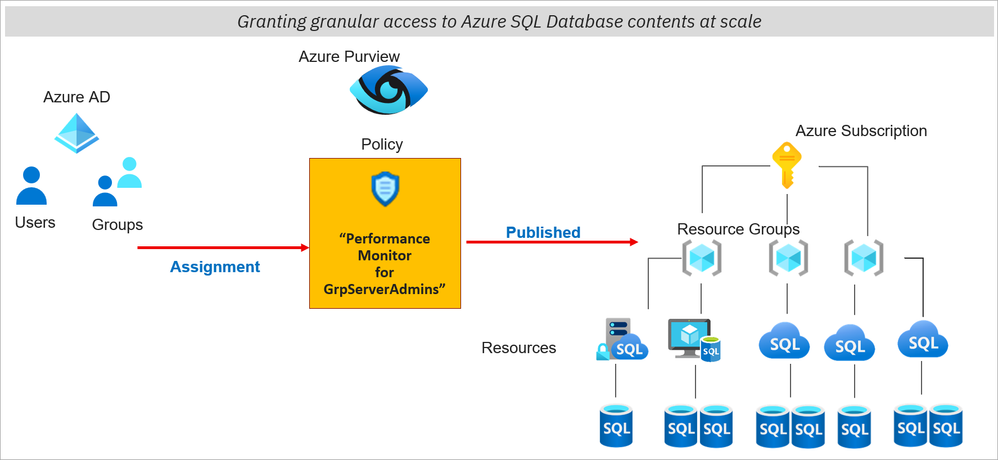
Using policies in Azure Purview, customers can create policies that allow Azure Active Directory Groups and AAD Users to access Azure SQL Database within a subscription.

These policies can be assigned at any level of the resource hierarchy (individual database, server, resource group or even whole subscription), and by that apply effectively to all SQL Servers and databases within the given resource scope.

Everything is deployed by Rest-API calls, which removes the need to run T-SQL in subsequent PowerShell scripts.

At the same time, access to the databases, since it is controlled from outside of the SQL engine, does not get mirrored from a primary database to its read-only replicas: what matters is where the database resides within the subscription hierarchy. This enables scenarios where Users need access to only either the read-only replica or the primary database but must not connect to the other copy of the database.

Covered functionalities

This first private preview covers the following use-cases:

SQL Performance Monitoring

A predefined set of permissions (called Action-Groups) that grant access to system metadata, that is commonly used for Performance Monitoring tasks, via a set of system views that are covered under these new permissions

SQL Security Auditing

A predefined set of permissions that grant access to system metadata, that is commonly used for Security Auditing tasks, via a set of system views that are covered under these new permissions

Technical background

For Purview Policies to have effect on a given database in Azure SQL Database, 3 things need to come together:

  1. The logical server must allow external policies to have effect – this requires owner-level permissions

At this stage, all databases under that logical server will in addition to the existing SQL permissions also understand new permissions that are coming from Purview Policies.
You can see this in this screenshot, where the queried DMV requires either the traditional SQL permission VIEW SERVER PERFORMANCE STATE or the new RBAC Action Microsoft.Sql/sqlservers/SystemViewsAndFunctions/ServerState/rows/select
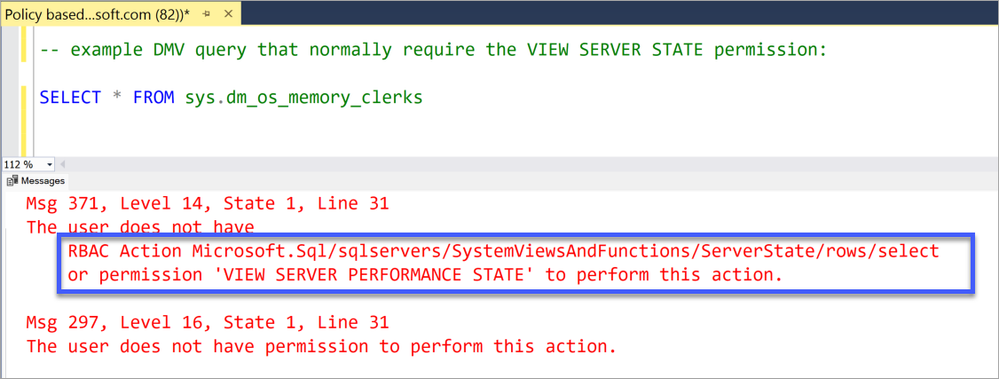
  1. The logical server must be registered in an Azure Purview Account

Together with step 1 this enables a 4-eye principle as it is required for SoD-compliant environments.

  1. A policy, using one of the 2 built-in Action-Groups must be created and published in Azure Purview Studio

Call to Action

At this point we are opening a private preview for a small audience only. If you would like to take part and have an early hands-on experience with this new capability, please use the following link to let us know, and we will get back to you when there is a slot available in the limited private preview.

Opt-in to private Preview

Further references

Security: The Principle of Least Privilege (POLP) – Microsoft Tech Community

Introduction to Azure Purview – Azure Purview | Microsoft Docs

Quickstart: Create a Purview account in the Azure portal – Azure Purview | Microsoft Docs

Azure Active Directory documentation | Microsoft Docs

Acknowledgement

This new capability is possible thanks to the collaboration between the SQL Security Engineering team and the Purview Data governance team. Many people have been involved across continents and time zones. Thank you all for your hard work!

Tags: Azure, Permissions
Share this entry
  • Share on Facebook
  • Share on X
  • Share on LinkedIn
https://andreas-wolter.com/wp-content/uploads/2026/10/tc-2945491-1.png 460 998 Andreas Wolter https://andreas-wolter.com/wp-content/uploads/2026/10/Andreas-Wolter-Data_Security_Architect-dark.png Andreas Wolter2021-11-11 13:26:002026-10-29 18:13:05Private Preview: controlling access to Azure SQL at scale with policies in Purview
You might also like
New Permissions in SQL Server 2025
Full day PreCon Practical Performance Analysis in Melbourne at Asia & Australia Tour 2018
When DROP USER Doesn’t Fully Drop Access: Stale EXTERNAL MODEL Permissions in SQL Server’s AI Integrations
Diagram: Split of VIEW SERVER/DATABASE STATE into VIEW SERVER/DATABASE PERFORMANCE STATE and VIEW SERVER/DATABASE SECURITY STATE Granular Permissions in SQL Server 2022 and Azure SQL: Least Privilege for Metadata, XEvents and Auditing
CONTROL SERVER vs. sysadmin/sa: permissions, system procedures, DBCC, automatic schema creation and privilege escalation caveats
Ownership Chaining Explicit Permission proposal My 7 wishes for access control in SQL Server and Azure SQL security
Separation of Duties (SoD) and role-based security conception in SQL Server
Security-issue: guest-guest impersonation
0 replies

Leave a Reply

Want to join the discussion?
Feel free to contribute!

Leave a Reply Cancel reply

Your email address will not be published. Required fields are marked *

Security Assessment Community Edition

Learn about my free Community Edition script.

Recent
  • Sample result in SSMS: local NTLM connections over shared memory from SQL01, and NTLM connections over TCP from a reporting server, an ETL server and a workstation
    NTLM Deprecation and SQL Server: How to Find NTLM Connections...18. November 2026 - 17:01in: Security
  • SQL Server Consolidation: $3M+ in Projected Savings and...30. September 2026 - 15:47in: Architecture & High Availability, Security
  • Using a Database Server as a Honeypot for Threat Detect...18. September 2026 - 16:00in: Security
  • Azure Arc for SQL Server: “Least Privilege” Mode Still...8. September 2026 - 15:56in: Security
  • When SIEM Enrichment Becomes False Attribution3. September 2026 - 14:26in: Security
Comments
  • Thanks Scott. Goof feedback. NETSTAT is a useful addition,...21. November 2026 - 15:44 by Andreas Wolter
  • I would go a little deeper with how to troubleshoot SQL...21. November 2026 - 15:15 by Scott O
  • Protecting database data at rest is essential for maintaining...21. October 2026 - 2:23 by Viska
  • Thanks Now Microsoft could document them as well, and put...19. August 2026 - 16:26 by Andreas Wolter
  • List of Action_IDs for Filter https://sqlquantumleap.com/reference/server-audit-filter-values-for-action_id/ Great...18. August 2026 - 0:59 by Peter Dünsch

Articles

Analysis Services Auditing Availability Groups Azure Best Practices Certification Columnstore Consolidation Deadlocks & Blocking Encryption Extended Events Get-SqlSafe In-Memory OLTP Indexing Least Privilege PASS Summit Patching Performance Analysis Permissions Privilege Escalation Reporting Services Security Principles Spatial Data SQLBits SQL Injection SQLSaturday SQL Server 2012 SQL Server 2014 SQL Server 2016 SQL Server 2022 SQL Server 2025 SQL Trace & Profiler sysadmin & Server Roles Threat Detection Vulnerabilities Workshop & PreCon
© 2026 Andreas WolterContactImprintPrivacy PolicyLinkedInRSS
Link to: Security concept: Audit Trail Link to: Security concept: Audit Trail Security concept: Audit TrailAudit records in Azure EventHub Link to: Log4j (CVE-2021-44228) and SQL Server: my part in Microsoft’s response Link to: Log4j (CVE-2021-44228) and SQL Server: my part in Microsoft’s response Log4j (CVE-2021-44228) and SQL Server: my part in Microsoft’s response
Scroll to top Scroll to top Scroll to top
Manage Consent
To provide the best experiences, we use technologies like cookies to store and/or access device information. Consenting to these technologies will allow us to process data such as browsing behavior or unique IDs on this site. Not consenting or withdrawing consent, may adversely affect certain features and functions.
Functional Always active
The technical storage or access is strictly necessary for the legitimate purpose of enabling the use of a specific service explicitly requested by the subscriber or user, or for the sole purpose of carrying out the transmission of a communication over an electronic communications network.
Preferences
The technical storage or access is necessary for the legitimate purpose of storing preferences that are not requested by the subscriber or user.
Statistics
The technical storage or access that is used exclusively for statistical purposes. The technical storage or access that is used exclusively for anonymous statistical purposes. Without a subpoena, voluntary compliance on the part of your Internet Service Provider, or additional records from a third party, information stored or retrieved for this purpose alone cannot usually be used to identify you.
Marketing
The technical storage or access is required to create user profiles to send advertising, or to track the user on a website or across several websites for similar marketing purposes.
  • Manage options
  • Manage services
  • Manage {vendor_count} vendors
  • Read more about these purposes
View preferences
  • {title}
  • {title}
  • {title}